Sunday, November 20, 2016

The 49 states of America

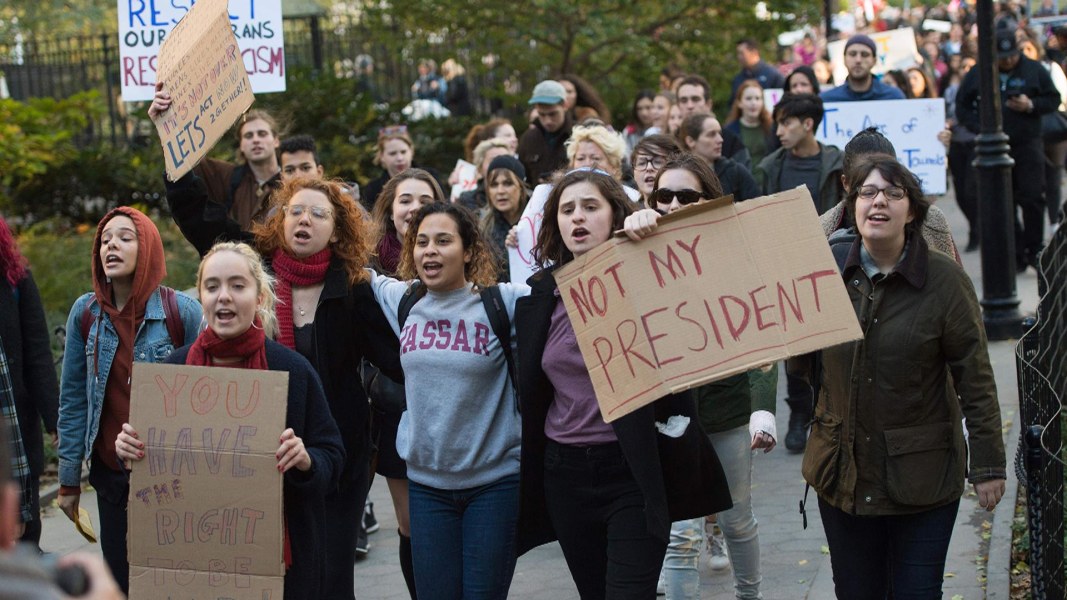
To say Donald Trump's win as new president didn't come lightly would be an understatement. From peaceful protests to violent riots, the people of America are not afraid to show how they feel about Trump, and California is no exception. Being a largely democratic state, as well as being one of the most diverse states, over 38% of people being Latino, California may be one of the biggest contenders in this nationwide sweep to get rid of Trump. So what do its people say about this matter?

According to an article by The Washington Post, Manuel Guerrero, a resident of Santa Ana, California, "is terrified by the impending presidency of Donald Trump and how it will affect Latinos like him." He says this as he and a few dozen other like-minded people prepare to protest Trump across a highway. It doesn't stop there however. The day after Trump's victory, thousands of people marched through the streets, blocked freeways, some even damaging property and businesses.  Adriana Garcia says Trumps presidency "might subject her , the daughter of Mexican immigrants, to racist and sexist hatred she has never experienced."


Among all this chaos, what is the solution to Trump? As many believe, secession from the country seems to be a growing option. With people using the term Calexit, in reference to Britain's Brexit, people rallying in Sacramento to get a secession referendum on the 2018 ballot, even Shervin Pishevar, co-founder and co-chief of Sherpa Capitol, saying he will begin to fund a "legitimate campaign" to make California its own nation, the people of California aren't joking around when they talk about secession.

But what does all of this prove? That California is a strong, independent state, able to secede and become its own nation? How about looking at the big picture. What this shows about America as a country, and what is shows to the rest of the world. It doesn't show that America, or California, is a strong nation, but rather a weak one that is unable to keep itself together when times become rough. It shows a democratic nation that becomes so distraught over the president they chose, that they find it necessary to protest, riot, and, in this case, even consider seceding. All of this done before our new president, Trump, is even given a chance to prove himself in office. And our neighboring countries, they fear us. They fear the thought of becoming like us. My friends have told me they wont visit America because they are scared of what is happening in our country.

Trump may not be a good president, and many say he will divide our country, but right now it is our own people that are doing the dividing. A country that was once founded upon "we the people" has turning into "we will only be the people when we get what we want." And if that is the case, then we were never "the people."

Friday, November 11, 2016

The future of Japan


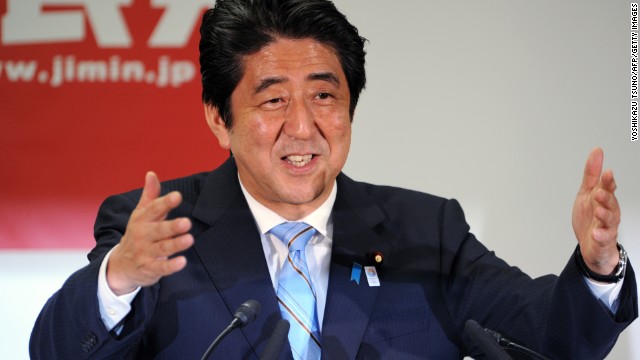
Since its fall in 1990, receiving the name "the lost decade", Japan's economy has been very unsuccessful in regaining the great growth it once had in the years following World War 2. Virtually always on the brink of recession, Japan's economy is in desperate need of help. Largely to blame from Japan's shrinking birth rate and aging work force, the current prime minister Shinzo Abe has been working to fix such problems. However, with recent news of Donald Trump becoming new president of The United States, even more fear has been set into the people of Japan, and an even harder task has been laid out for Mr. Abe

Quick to recover from the shocking news, by Wednesday night Abe had already called Trump to set up a meeting for the following week in New York. "In hustling to be one of the first world leaders to meet with Mr. Trump since the election, Mr. Abe is seeking to gauge the sincerity of Mr. Trump's campaign rhetoric on Japan." said Motoko Rich for The New York Times. Luckily for Japan, Abe understands what this situation might unfold and has acted accordingly. Japan relies strongly on America's military for support, as well as completely relying on America for nuclear deterrence, and the loss of any of these assets could put Japan in a lot of trouble. With North Korea becoming bolder in the testing of its atomic weapons, as well as China repeatedly sending vessels, including a warship a few months past, into disputed waters near Japanese controlled islands, tensions are increasing as Japan is put into an uncomfortable position.


Along with these issues of military protection, Japan still has its failing economy to worry about. Despite Abe's failing plans to revitalize the economy, there was still hope in the Trans-Pacific Partnership, a trade agreement between The United States and several Asian countries including Japan, which was recently approved by Japan's lower house of parliament, moving closer to ratification. However, with Trump moving into presidency, any hope of the treaty passing seems gone. As well as the increase of the Japanese yen, possibly made even stronger with Trump as president, even more issues are being made for Japan, as this increase will in turn result in a decrease in exports as well as many other problems, only making it worse for Japan's economy.

Despite Abe's seemingly unsuccessful plans to bring back Japan's economy, he has still proven to be a greater source of stability than many past leaders. You can see this from simply looking at Japan's recent history of prime ministers. Since 2007, Japan has had six different prime ministers, yet since being elected in 2012, Abe has held his position, proving that there is some form of trust between him and the people of Japan. Perhaps the real thing Japan needs is time, which it hasn't had in previous years with its yearly rotation of leaders between 2006 to 2012. Nonetheless, if Abe can successfully build a healthy relationship with Trump, along with adequate time, Shinzo Abe could finally bring Japan salvation from its steadily failing economy.


Tuesday, November 8, 2016

A better form of government?


Nearly 20 years since the last core leader Jiang Zemin, China came back to old tradition with the promotion of president Xi Jinping. To outside countries such as America, this promotion might appear as a bad move for China, but why does China or similar countries not see it the same way?
From America's creation, it was formed upon a democratic government, a government that specifically acts against one man coming to power, which is exactly what China is allowing to happen in this case. When we look at China however, opposite of America, it was born upon a communist foundation. So to the people of China, having one man be in such power is all they know, and that is how they believe China should be run. I think most can agree that the majority of American citizens are in support of a democratic government, and would frown upon any form of communism, but as I stated before, that is because our country was born on democracy, and that is all we know. To Americans, democracy is the form of government that has kept our country standing all this time, so it must be the right choice. 


Now look at China. most Chinese would be in favor of their government. In fact, when asking what my friend's opinion on promoting Jinping was, she was highly in favor, stating "He really contributes much to many aspects. He is very wise, full of wonderful policy." etc. She had no hesitation towards one man holding so much power, but rather looked only towards what he can do for the country, where as Americans might do the complete opposite. Look at only what bad things that man will do with his power; and, once again, I think this all leads down to what principles a nation was founded on.

Many might look towards China's past as evidence of a poor form of government, specifically Mao Zedong, but again, this all falls down to peoples mindsets. to many, Mao was a ruthless dictator that was terrible for China, but to the Chinese, he is rather an important figure that they look up to, and one that helped make China what it is today. Once again, when asking my friend her opinion on Mao, to my surprise, she said he was the greatest. When telling her about the "bad" or controversial acts he committed, she stated "You can't blame it all on Mao...what he contributed matters much more than what he ruined. Without Mao there is no China." 

I believe that there is no clear form of government that is better than the rest, and to know what is good for a country, you need to see what is good for the people and what they want. In China's case, promoting Xi Jinping is what the people want, and overall I believe is a step in the right direction for the country.